
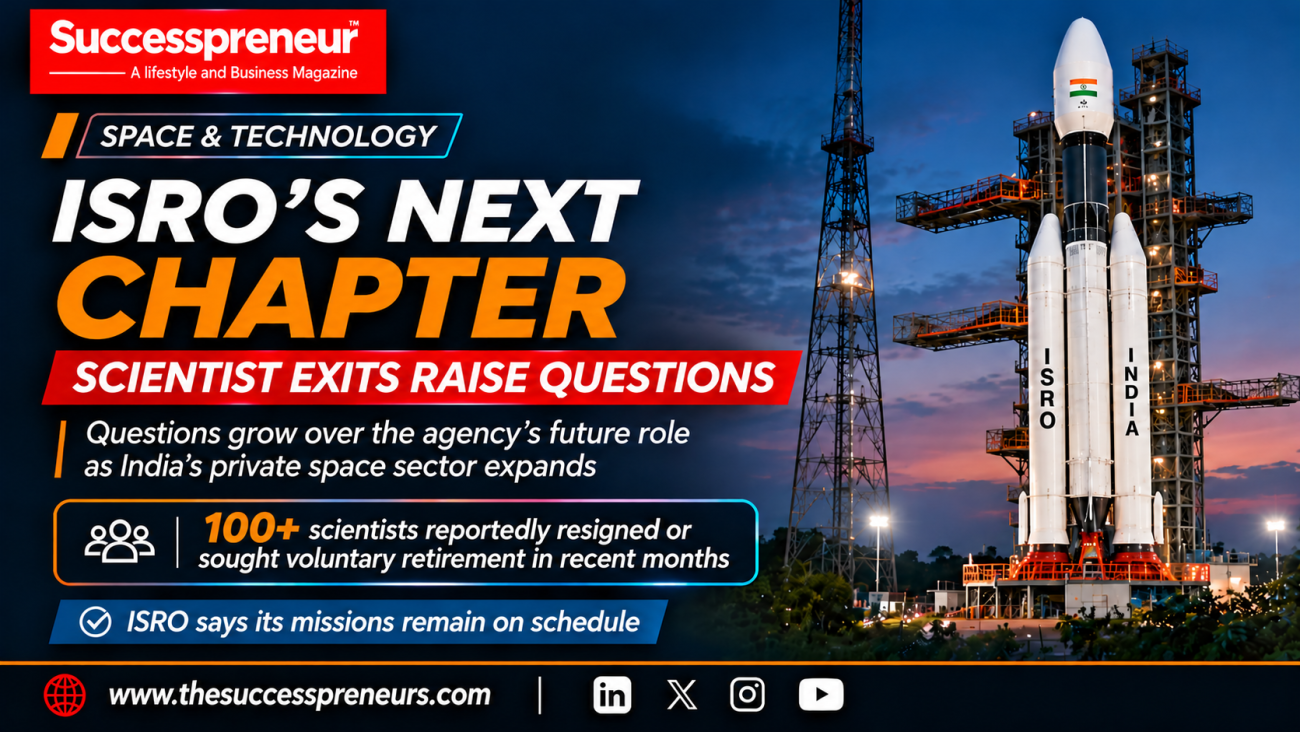
ISRO’s new chapter: Among resignations, questions remain about future role
India’s space sector is undergoing a major transition as private companies take on a larger role in manufacturing rockets, satellites and other commercial space technologies. The government aims to build a portfolio of six launch vehicles and achieve 50 launches annually by 2030. While startups such as Skyroot Aerospace are expanding their capabilities, ISRO is expected to focus more on research, advanced technologies and strategic missions.
Shifting Priorities
The expansion of private participation is not intended to replace ISRO but to strengthen India's overall space ecosystem. Industry leaders believe ISRO should concentrate on human spaceflight, planetary exploration, scientific missions and high-risk technologies, while private companies handle repeatable commercial activities. This transition is also expected to reduce ISRO's operational workload and allow it to focus on advanced research.
An Organisation in Transition
The Indian Space Policy 2023 states that mature technologies and systems should be transferred to industry for commercial use, allowing ISRO to prioritise research and development. However, nine employee associations have sought clarity about the future of the organisation, particularly regarding manufacturing responsibilities, technology transfers, recruitment and employee safeguards. ISRO Chairman V Narayanan has clarified that the organisation will remain a government body and will not be privatised.
Reports estimate that around 100–120 scientists left ISRO earlier in 2026, although the organisation has not released official departure figures. Former employees and industry experts point to factors such as repetitive work, better opportunities in private companies and higher education. However, some believe the departures are manageable given ISRO's size and continued recruitment.
The Support ISRO Provides
Private space startups continue to depend heavily on ISRO's infrastructure, technical expertise and established supply chain. Its qualified domestic vendors help companies source components locally, while its testing facilities support the validation of satellites and other space technologies. Technology transfers also allow startups to use proven components instead of spending several years developing them independently. IN-SPACe has simplified access to these facilities through a single-window system, although limited testing capacity remains a challenge.
What’s Next
The future model is expected to involve ISRO developing advanced and high-risk technologies before transferring mature systems to private companies for commercial production. Startups can then scale these technologies through business opportunities, while ISRO focuses on long-term national and scientific priorities. So far, IN-SPACe has facilitated 118 technology transfer agreements. However, questions about ISRO's future responsibilities and employee concerns remain as the space policy is gradually implemented.
The future model is expected to involve ISRO developing advanced and high-risk technologies before transferring mature systems to private companies for commercial production. Startups can then scale these technologies through business opportunities, while ISRO focuses on long-term national and scientific priorities. So far, IN-SPACe has facilitated 118 technology transfer agreements. However, questions about ISRO's future responsibilities and employee concerns remain as the space policy is gradually implemented.
Add New Comment